
Sovereign Communications: Retaining Control of Critical Infrastructure
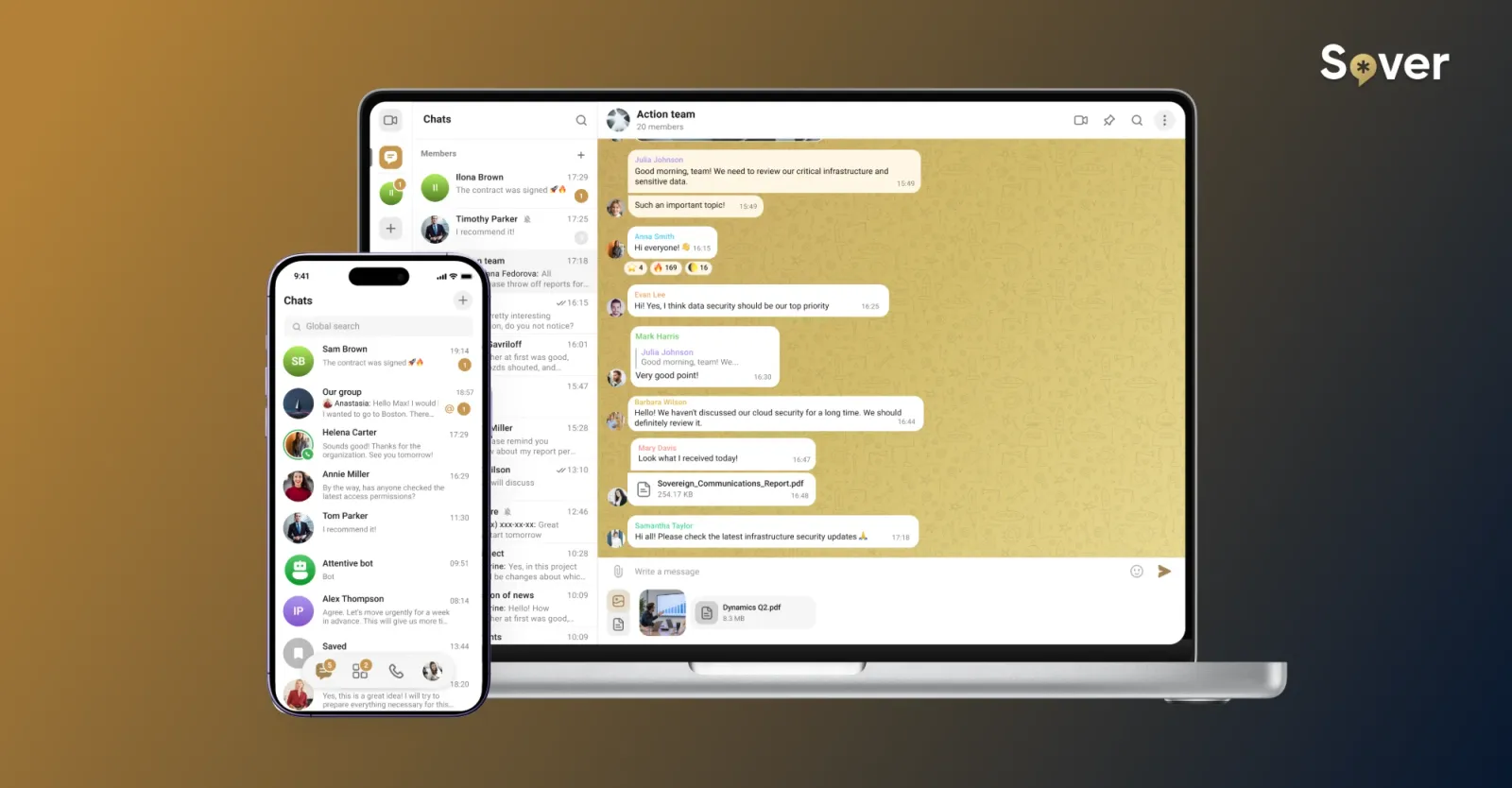
Over this year, a clear trend has emerged in enterprise technology: more companies are moving business-critical systems back onto infrastructure they control. Communication systems, platforms for managing and automating daily business activities, customer-interaction tools, AI services, and other business-critical frameworks are increasingly viewed as operational assets.
Public cloud still offers scale, flexibility, and availability. But recent large-scale incidents at cloud providers have shown that concentration creates risk. When thousands of companies depend on the same infrastructure, a single disruption can affect entire industries.
For communications, the stakes are especially high. Messaging, calls, video meetings, file sharing, and AI-assisted workflows carry internal decisions, crisis coordination, sensitive documents, and customer interactions. When these systems fail, the company loses its ability to coordinate.
A Changing Risk Landscape
In 2026, security trackers highlighted heavy cybercrime activity across India, the United States, Australia, the United Kingdom, France, South Korea, Japan, Canada, Germany, and the Czech Republic, targeting sectors like banking, aviation, utilities, retail, and transit.
At the same time, the concentration of critical infrastructure in a limited number of large public data centers has created a systemic vulnerability. A physical incident, man-made disruption, or large-scale operational failure at one facility has the capability to disrupt multiple sectors simultaneously, much like the recent Microsoft Outlook and Teams outage.
This is not an argument that every company should abandon public cloud. It’s an argument that business-critical systems require a more deliberate approach to risk. Companies are concerned whether they can continue operating if their external dependencies fail.
Why On-Prem Is Returning
On-prem infrastructure is returning because it addresses a need that public cloud can’t always satisfy. Companies want direct control over the systems their operations depend on and host communications within their own infrastructure. They want to keep sensitive data inside their security circuit, decide where data is stored, reduce external dependencies, govern access, integrations, and AI processing under their own policies.
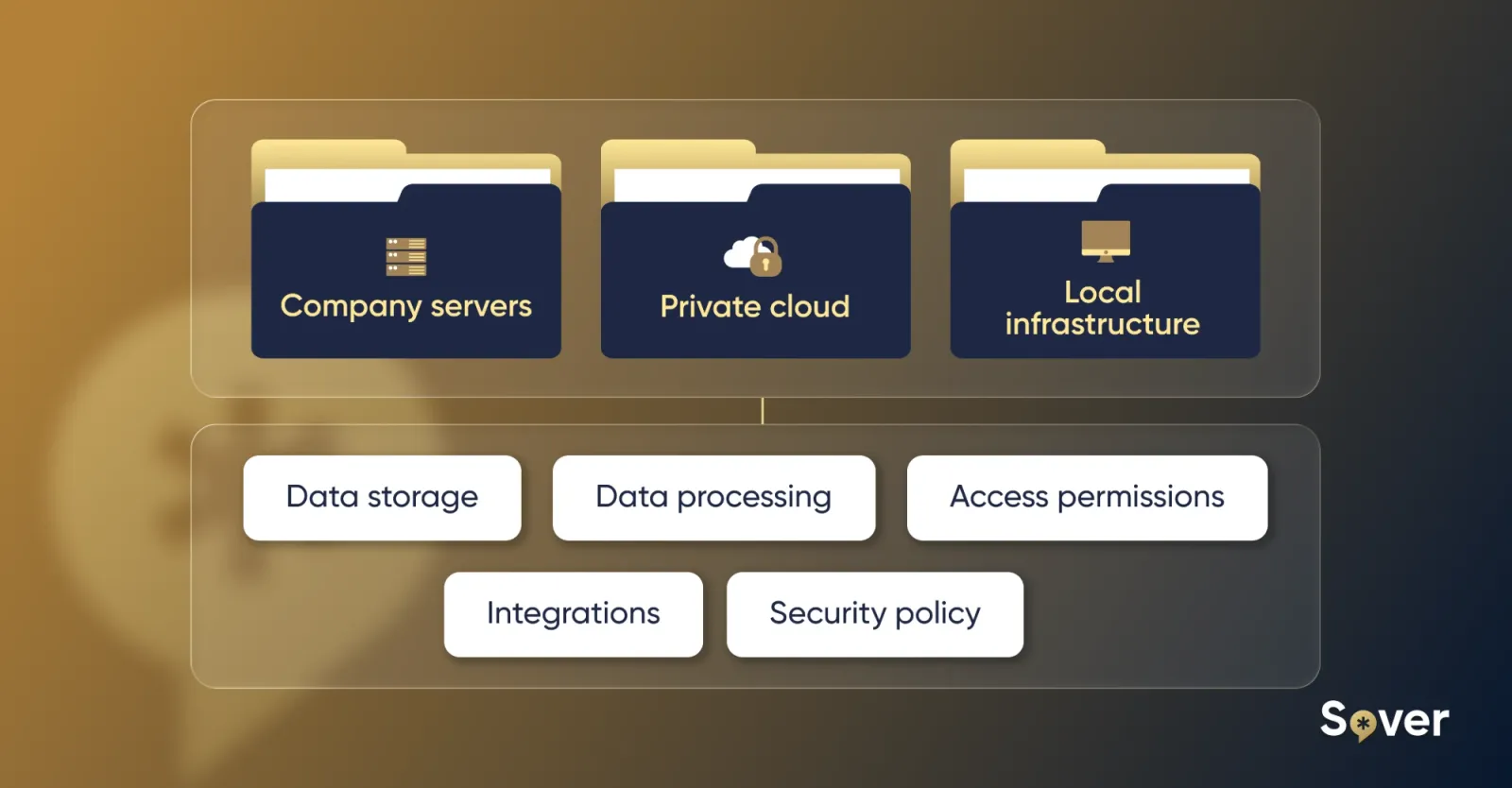
Deploying communications on company servers, private cloud, or local infrastructure allows it to retain authority over data storage, processing, access, integrations, and security policy. It also enables a parent company to serve branches and subsidiaries within a unified environment, with flexible access management.
- Government agencies, critical-infrastructure operators, and banks need to meet regulatory requirements and have mature IT capabilities to do so.
- Keeping communications integrated into internal systems within the corporate security perimeter reduces external attack vectors.
- AI transcription, meeting summaries, and document analysis require sensitive data to remain inside the organization’s infrastructure.
Sover brings this model to unified communications. It’s deployed on the company’s own servers, enabling it to run the infrastructure, own the data, and determine what leaves its environment.
Deep Integration with Internal Systems
Business systems rarely operate in isolation. Communications platforms connect to identity providers, document systems, CRM tools, ticketing systems, operational databases, telephony, and AI services.
Every integration that crosses an organizational boundary can create an additional attack vector. Data may leave the corporate network, third-party services may receive sensitive context, and security teams must manage more external dependencies. More and more often, companies prefer to keep critical integrations within their own security circuit. This allows them to apply consistent policies to identity, access, logging, encryption, and data flows.
Sover supports integration through APIs and bots, enabling companies to connect approved systems and automation to their communications environment while retaining control over the deployment and its security policy.
AI and Sensitive Data
AI has made the location of data a first-order business question.
Companies increasingly use AI for a wide variety of applications. These capabilities can create major productivity gains. But they can also turn a communications platform into a channel for highly sensitive information. So the question is whether sensitive recordings, internal discussions, customer data, and strategic documents should be sent to external servers for processing.
For many governments, financial institutions, healthcare organizations, and enterprises, the answer is no. They need AI capabilities that operate under their own security policy, within their own infrastructure, and with clearly defined permissions.
Sover: The Sovereign Communications Control
Sover is more than a messenger. It is a sovereign communications platform designed for governments and regulated organizations that need full control over where communications are processed and stored.
- It brings messaging, group chats, channels, voice and video calls, video conferencing, file sharing, workspaces, departments, projects, video library, and LLM integrations into one environment the customer hosts and controls. Sover includes AI agents and assistants that can participate in chats and calls through its chatbot API.
- Security controls run on infrastructure the customer operates: mandatory two-factor authentication, role-based access, device and session management, administrative audit logging, and encryption in transit and at rest. Secret chats add end-to-end encryption.
- Sover is designed to handle more than 1,000 messages per second and support hundreds of thousands of users. That matters most when communication volume spikes during a crisis, outage, or major operational event.
- Sover supports federation between independent instances. This allows agencies to collaborate while each retains control of its own deployment and determines what crosses to its partners.
- The Sover platform can be deployed on the organization’s own servers, Kubernetes cluster, or virtual machines. It is available for Windows, macOS, Linux, Android, iOS, and the web.
For organizations that treat communications as critical infrastructure, Sover offers a practical answer: modern collaboration capabilities without surrendering control, the data, or the rules that govern them.